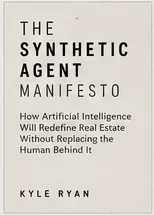
This is where the whole thing started.
I did not set out to write a theory about artificial intelligence. I was trying to solve a much more practical problem: smart people were buried in noise, software kept adding work instead of removing it, and “productivity” had become a substitute for knowing what actually mattered.
“We needed something that could think with us, not just for us.”
That sentence became the spine of the book.
We do not have a productivity problem.
We have an alignment problem.
More tools did not automatically create better decisions. More dashboards did not create clarity. More automation did not make the work feel more human.
“We don’t have a productivity problem; we have an alignment problem.”
I was never interested in adding one more piece of software to the pile. I wanted the system around a person to know enough context that it could remove friction and help with the next decision.
The human stays at the center.
The first edition is explicitly about real estate because that was the laboratory I knew best.
Clients do not hire data. They hire trust, confidence and clarity. A machine can process more information, remember more context and move faster than a person. None of that automatically makes it better at being accountable for a human decision.
“The goal isn’t to remove people from the process; it’s to remove the friction that keeps them from performing at their highest level.”
That is still the standard.
Data is not direction.
Most systems are very good at showing people more information.
The useful system interprets the information.
It does not stop at what happened. It helps answer the harder question: what should I do next?
That was the distinction I was trying to make in the book. Automating the action is easy. Knowing enough context to decide whether the action should happen is the interesting part.
The line we do not cross.
The original manifesto drew a line around identity before synthetic media became an everyday problem.
There is a difference between using AI to help you become more effective and using AI to pretend to be you.
“Synthetic intelligence should never replace authenticity. It should enhance it.”
If a system can speak in your voice, generate your face or imitate your decisions, capability is no longer the only question.
The question becomes whether the person on the other side knows what is real.
Trust is not a technical detail.
The manifesto.
“We are not here to be replaced. We are here to evolve.”
The future I was arguing for was never human or artificial.
It was human judgment surrounded by increasingly capable machine memory, analysis and execution.
The technology handles more of the friction.
The human becomes more responsible for the judgment.
That idea became bigger than the original real-estate context, which is why this publication exists now.
What changed after 2025.
The technology got better faster than I expected.
Search started becoming conversational. Models learned to browse and cite the live web. Agents moved from answering questions toward taking actions. Synthetic media got good enough that identity and provenance stopped feeling theoretical.
The original argument still holds.
It just has more places to go.
Technology does not replace the human. It reveals what the human is truly capable of.